
Essay · January 2025
Fela Anikulapo Kuti: The Flippin' Coin
Beneath the Black President's fiery rhetoric lay humour, spiritual evolution, and a nuanced view of power. Flipping the coin on Fela Anikulapo Kuti.
By Yemisi Johnson · 10 min read
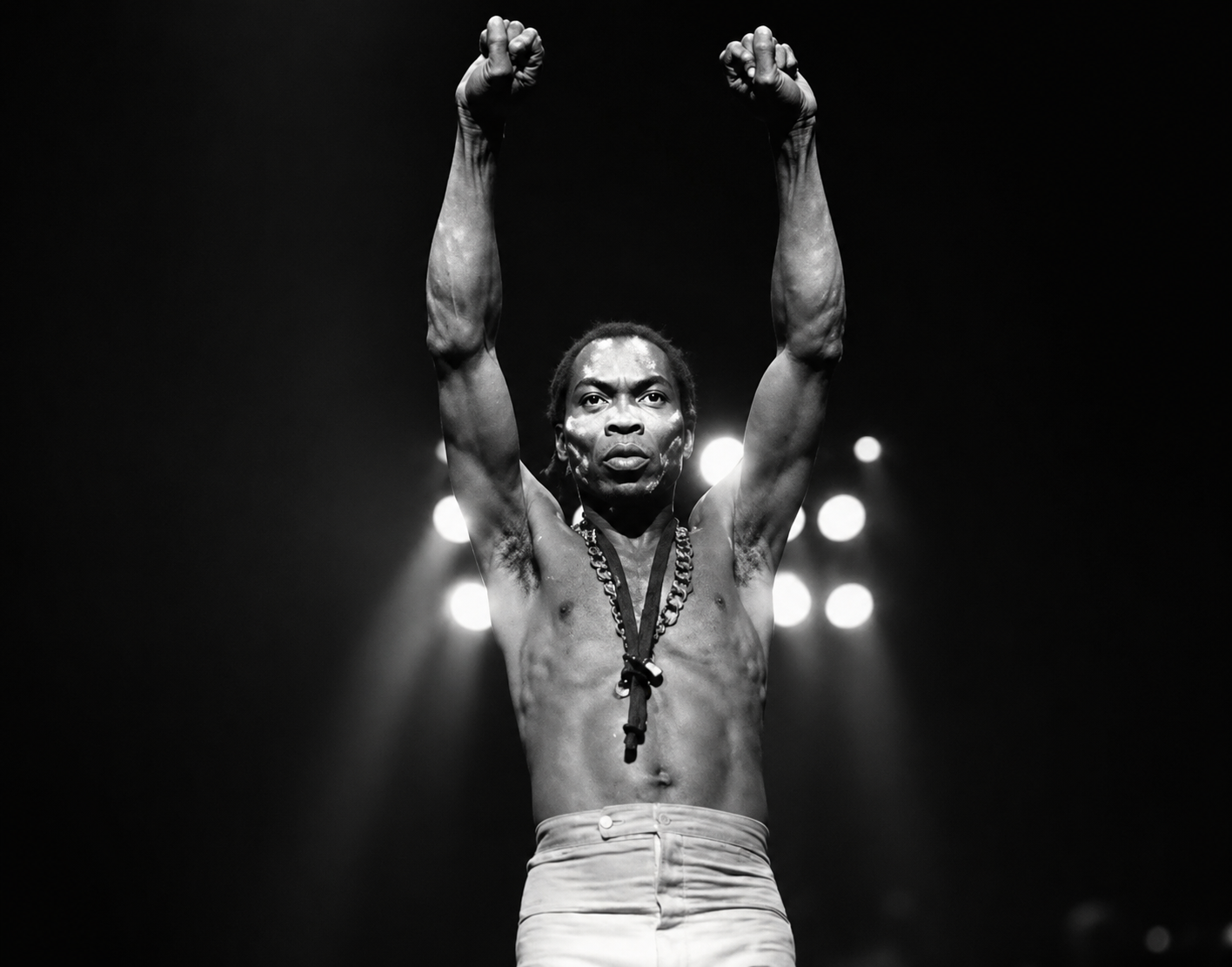
The name Fela Anikulapo Kuti conjures images of Afrobeat rhythms, political activism and an unapologetic rebellion. Also known as the "Black President," his life was a representation of African music and revolution. Yet, beneath the public persona of a fearless agitator lies a man of profound complexity, with philosophies and contradictions that paint a fuller picture of his humanity. To truly appreciate Fela, one must flip the coin to examine the often-overlooked facets of his life: his humor, spiritual evolution, and the softer ideologies that subtly shaped his legacy. This essay aims to examine the historical figure; Fela Anikulapo Kuti.
Fela's humor, often masked by his fiery rhetoric, was a defining yet underappreciated trait. In his music, satire played a central role, exposing societal ills with a wit that was both biting and entertaining. Songs like "Sorrow Tears and Blood" and "Zombie" used caricatured lyrics and catchy beats to ridicule oppressive regimes, turning the grim realities of corruption and militarism into moments of collective laughter and reflection. But his humor extended beyond his art; those who knew him personally recall his playful banter and a sharp, mischievous sense of irony. This lighter side of Fela was critical in making his heavy messages palatable to a wide audience, ensuring that his critiques resonated without alienating listeners.
Another lesser-known dimension of Fela's life was his deep engagement with spirituality, which evolved over time. While he is often remembered for rejecting Christianity and Islam, he embraced traditional African spirituality. Influenced by his mother, Funmilayo Ransome-Kuti, and other Pan-Africanists of his time, Fela viewed spirituality as a means of reclaiming African identity. His commune, the Kalakuta Republic, and his performances were steeped in rituals and symbols that celebrated the Yoruba tradition. His spiritual practices were as much about communal bonding and cultural pride as they were about personal enlightenment. This adaptability in his beliefs showcased a man who was both rooted in tradition and open to reinterpretation, blending the sacred with the political in a uniquely transformative way.
Perhaps most surprising, however, was Fela's nuanced view of power and leadership. Despite his anti-establishment stance, Fela was not opposed to the idea of governance; he was opposed to its misuse. His establishment of the "Movement of the People" and his brief foray into politics reflected a vision of leadership that prioritized accountability and grassroots empowerment. Yet, Fela was acutely aware of his own contradictions. He often wrestled with the balance between being a voice of the people and a figure of authority himself, acknowledging in rare moments of introspection that the pedestal of leadership was both a blessing and a burden.
Fela Anikulapo Kuti's legacy is often painted in broad strokes: the maverick musician, the fearless activist, the cultural icon. But the other side of the coin reveals a man of layered complexities. To truly understand Fela is to embrace these contradictions, for they are what made him.
, End ,